 English
 Dansk
Dansk Deutsch
What if every visitor could explore your collection their own way?
Meet Henry – a guide your visitors talk to, who listens, answers questions and follows their curiosity through the room.
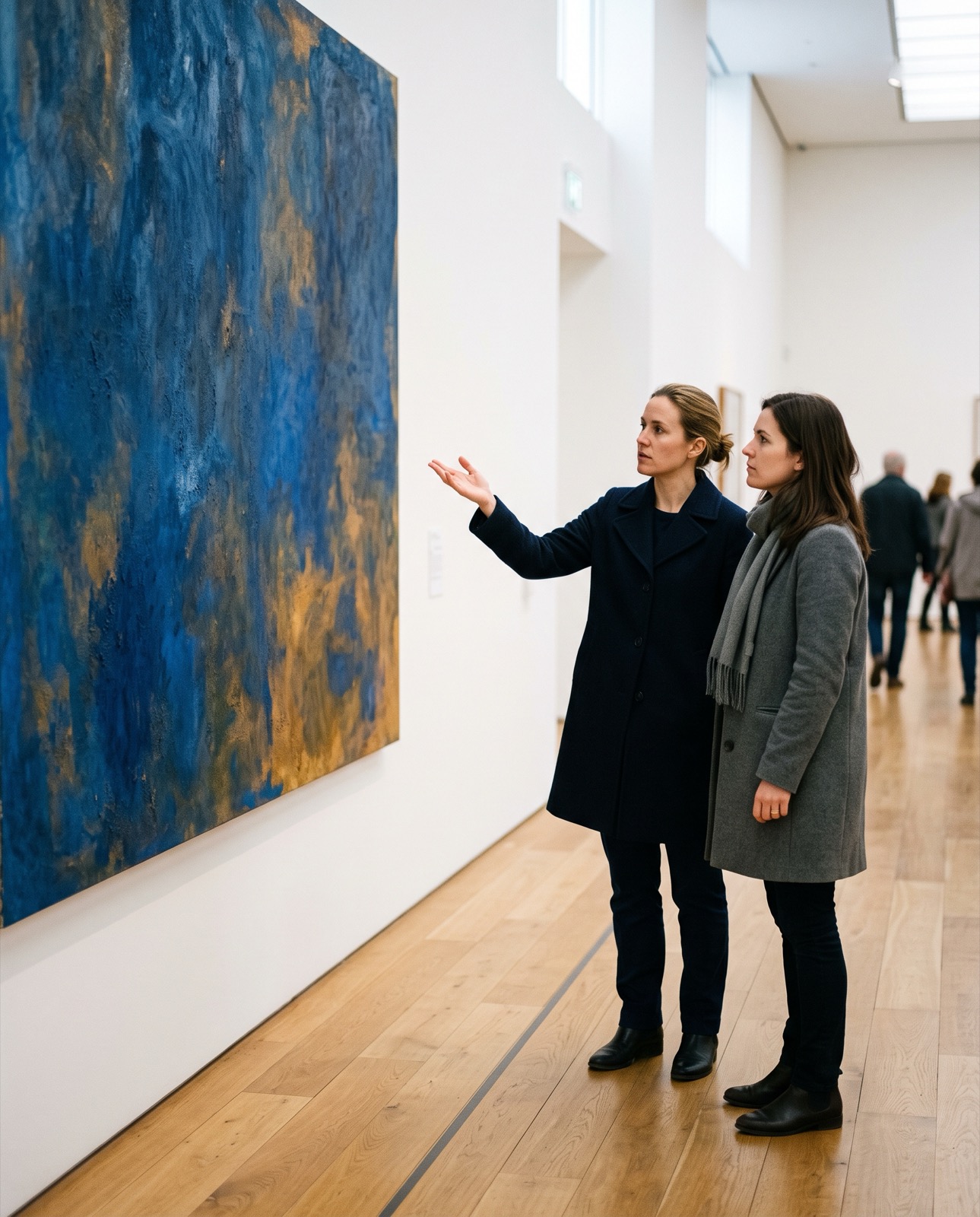
You talk. He answers.
A visitor stands in front of a work and says what is actually on their mind.
The visitor asks
“Can we go back to the hare you told me about? How did he paint the fur like that?”
Henry
“With a brush that ended in barely a few hairs, and a great deal of patience. He laid a wash down for the body first, then drew the fur on top of it, strand by strand, some of them lighter so they catch the light along the edge of the ear. And look at the eye: there is a window reflected in it, with the cross of its frame. He painted the room he was sitting in.”
The visitor asks
“Was it painted from a live one?”
Henry
“That is argued about, and I would not want to settle it for you. A hare that sat still would have been unusual; some think he worked from a dead animal, some from a tame one, some from studies he made over time. What is not in doubt is how closely he looked – closely enough to put his own window in its eye.”
The questions are real visitor questions; the recording is re-enacted.
Henry can ask back.
A recorded guide only plays. Henry can put a question to the visitor – what do you think she was looking at? – and then wait for the answer.
It sends the eyes to the work a second time. That is all the question is for: not to test anyone, but to make them look again.
No number to find, no code to scan, no screen to read.
A recorded guide has to be operated. The visitor finds the number, keys it in, and hopes it is the right one. Henry is not a menu: the visitor looks at something and asks, out loud, in their own words.
Where your museum has set a route, a question does not derail it. Henry answers, then picks the tour back up. And the visitor never has to work out how to use anything, which is the main reason their eyes stay on the object.
Look. Ask. Listen. Explore.
- Look
- →
- Ask
- →
- Listen
- →
- Ask again, or walk on
One collection. Many experiences.
He answers each visitor in their own language, six of them today, at the depth they came for – adapting to what they say, never to who he guesses they are.
- A child
- Someone in a museum for the first time
- Someone who has read the catalogue
- Someone whose language is not the one on the wall label
- Someone with twenty minutes
- Someone who would stay an hour with one painting
The visitor asks
“Äh, ist das Schloss jemals angegriffen worden? Gab es hier Kämpfe?”
“Er – has the castle ever been attacked? Was there fighting here?”
Henry
“Ja, dieses Schloss wurde mehrfach zum Schauplatz von Kämpfen. Im Mittelalter belagerten König Waldemar Atterdag und später König Erik von Pommern die Burg; beide Male endete der Streit jedoch durch Verhandlungen statt durch eine Erstürmung. Im Deutsch-Dänischen Krieg von 1864 wurde Sønderborg schwer vom Krieg geprägt: Nach der Niederlage bei den Düppeler Schanzen diente es als Lazarett für verwundete dänische Soldaten, bevor preußische Truppen einzogen.”
“Yes, this castle was the scene of fighting more than once. In the Middle Ages King Valdemar Atterdag laid siege to it, and later King Erik of Pomerania; both times the quarrel ended in negotiation rather than assault. In the war of 1864 Sønderborg was badly marked: after the defeat at the Düppel redoubts it served as a hospital for wounded Danish soldiers, before Prussian troops moved in.”
The visitor asks
“Can you tell me something more interesting?”
Henry
“Here’s a delicious reversal: in 1882, the modest Aluminia faience factory bought the grand Royal Copenhagen porcelain manufactory.”
The visitor asks
“Okay, you told me that already. I want to hear a different story.”
Henry
“Then let’s leave the factories behind. In 1790, Denmark began making the Flora Danica service as a grand gift for Catherine the Great of Russia. But she died before it was finished, so the porcelain never reached her table. A diplomatic gift turned into a family treasure, still appearing at important Danish dinners centuries later.”
The questions are real visitor questions; the recordings are re-enacted.
One guide, the depth each visitor came for.
The same guide, the same knowledge. Only the question is different, and nobody was asked to pick a level.
The visitor asks
“Who is the Grauballe Man?”
Henry
“The Grauballe Man is a man who lived in Denmark more than two thousand years ago, during the Iron Age. The bog where he was laid preserved his skin, hair, and hands, so we can still see him today. We do not know his name, but we can remember that he was a real person, not a monster or a statue.”
The visitor asks
“What is the current interpretation of the deposition?”
Henry
“The current interpretation is cautious: Grauballe Man was probably deliberately killed and deposited as a ritual offering. We cannot know the precise circumstance – sacrifice, punishment, or another rite – so ‘probable ritual deposition’ is safer than claiming a single certain motive.”
The questions are real visitor questions; the recordings are re-enacted.
And when nobody knows, he says so.
That is what makes everything else he says worth believing.
Henry is a conversational AI guide. He never pretends to be a person, and if a visitor asks, he says so.
The visitor asks
“How many months did it take before the playground was finished?”
Henry
“I’m afraid I don’t know that for certain, and I’d rather not guess. I have no information on how long the playground took to build. The staff at the entrance might be able to tell you.”
The visitor asks
“What can you tell me about Marianne von der Esquin?”
Henry
“I can’t place that name with certainty right now. Do you perhaps mean Marianne von Werefkin, who is here with Sturmwind, or another Marianne with a similar name? Just tell me what you can see on the work, or how the name looks on the wall label, and we’ll pin it down together.”
The visitor asks
“I wanna see Gustav Klimt.”
Henry
“I don’t see anything specific here linking Klimt to a work or a room in this museum, and I don’t want to invent a presence for you that may not exist.”
The visitor asks
“OK, but what about Gustav Klimt?”
Henry
“I don’t want to mislead you: I have no reliable information here indicating that a work by Gustav Klimt is on show in this museum at the moment. You do sometimes see Klimt in temporary exhibitions elsewhere in Amsterdam, but here the collection revolves mainly around Van Gogh and his contemporaries.”
The questions are real visitor questions; the recordings are re-enacted.
Three ways of not knowing: the record is silent, the name will not resolve, and the work is not in the building. None of them is an apology.
Experience Henry for yourself.
The quickest way to understand it is five minutes with it running.