English
 Dansk
Dansk Deutsch
When a child can ask their own question.
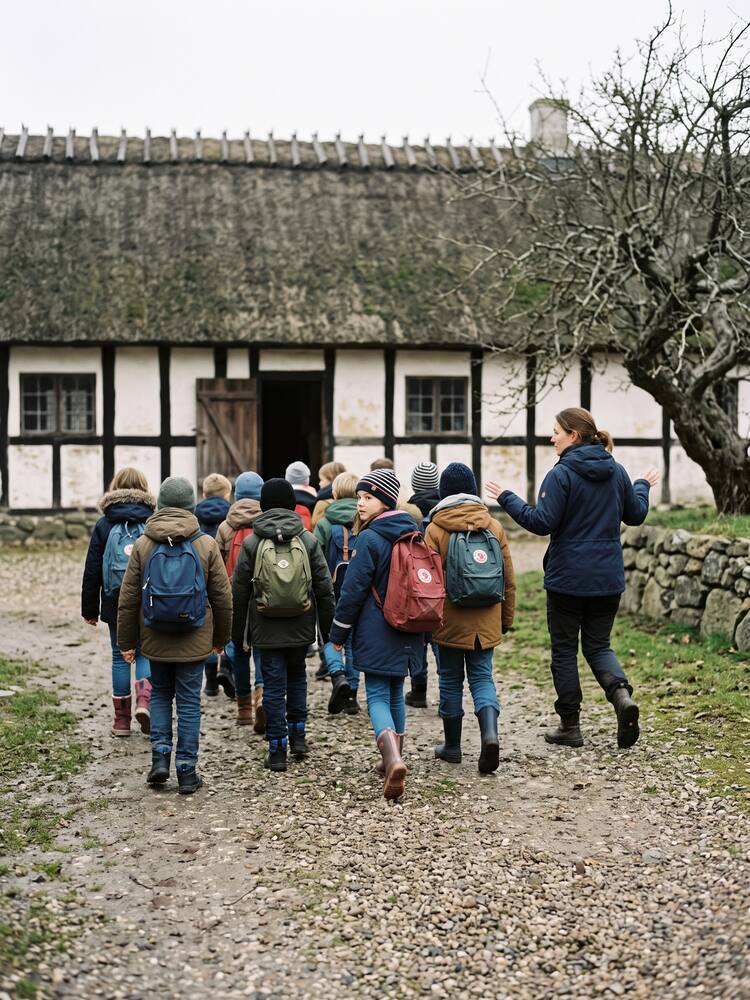
A class arrives full of questions, and they ask them where the curiosity happens – in front of the thing itself. One educator, twenty-five children, and an hour.
One shared voice, not twenty-five screens.
A class hears Henry together, over a speaker, on the museum’s own equipment. The teacher leads: the raise-your-hand moments, the hand-backs, the pace. Henry answers on cue.
This is deliberate. Handing every child a phone fragments a visit, and schools have their own rules about phones in lesson time. A conversation the whole class is inside does the opposite.
The teacher facilitates
Henry is a tool in the educator’s and the teacher’s hands, not a replacement for either.
The museum’s equipment
A shared speaker and the museum’s or school’s devices. Never the pupils’ own phones.
Their own words
Children ask with fewer boundaries than adults. He answers the question that was actually asked.
The visitor asks
“Did they really have Bluetooth back then?”
Henry
“The other way round – the technology is named after the king. Harald Bluetooth ruled here, and the nickname came from a bad tooth. A thousand years later two engineers needed a name for something that joined different devices together, and they picked him, because he joined Denmark and Norway together. The symbol on your phone is his two initials, cut as runes.”
The question is a real visitor question; the recording is re-enacted.
Half a joke, and a real question underneath it. He takes it seriously without correcting the child.
What the children asked comes back to you.
Every question is captured and can be read back by theme, by type and by depth. It is the closest a museum gets to hearing what its own collection sounds like from a metre off the floor – and it is design material for whatever the museum builds next.
No personal data about pupils is collected.
A class gets the same honesty as a specialist.
Where the experts disagree, or the record simply does not say, Henry tells them so instead of picking an answer.
The teaching programme is yours to write. We build what carries it.
Extending it into the classroom, before and after the visit, is something we would design with you.
A class can meet the place before they get there, which for some children changes the whole visit.