Give every visitor a guide of their own.
A more personal way to experience your collection. AITourPilot gives your visitors a conversational AI guide – one they can talk to, ask questions of and explore with, adapting to their curiosity as they go.
The visitor asks
“I only see an old farmhouse. Can you tell me something exciting?”
Henry
“Oh, absolutely! This place is full of storms, shipwrecks, secret messages and daring rescues. Picture the Elisabeth Rickmers crashing onto the beach while waves thundered around it, and nineteen sailors racing through the darkness toward this farmhouse.”
Your visitors are not all the same. Why should their museum experience be?
Visitors arrive with different interests, different knowledge, different languages and very different questions. A recording can only hold one story, and it tells that story the same way to everyone who presses play.
Henry answers the question that was actually asked. He adapts to what a visitor says and does, not to who he thinks they are: he never tries to work out someone’s age, their education, or how serious they are about any of it.
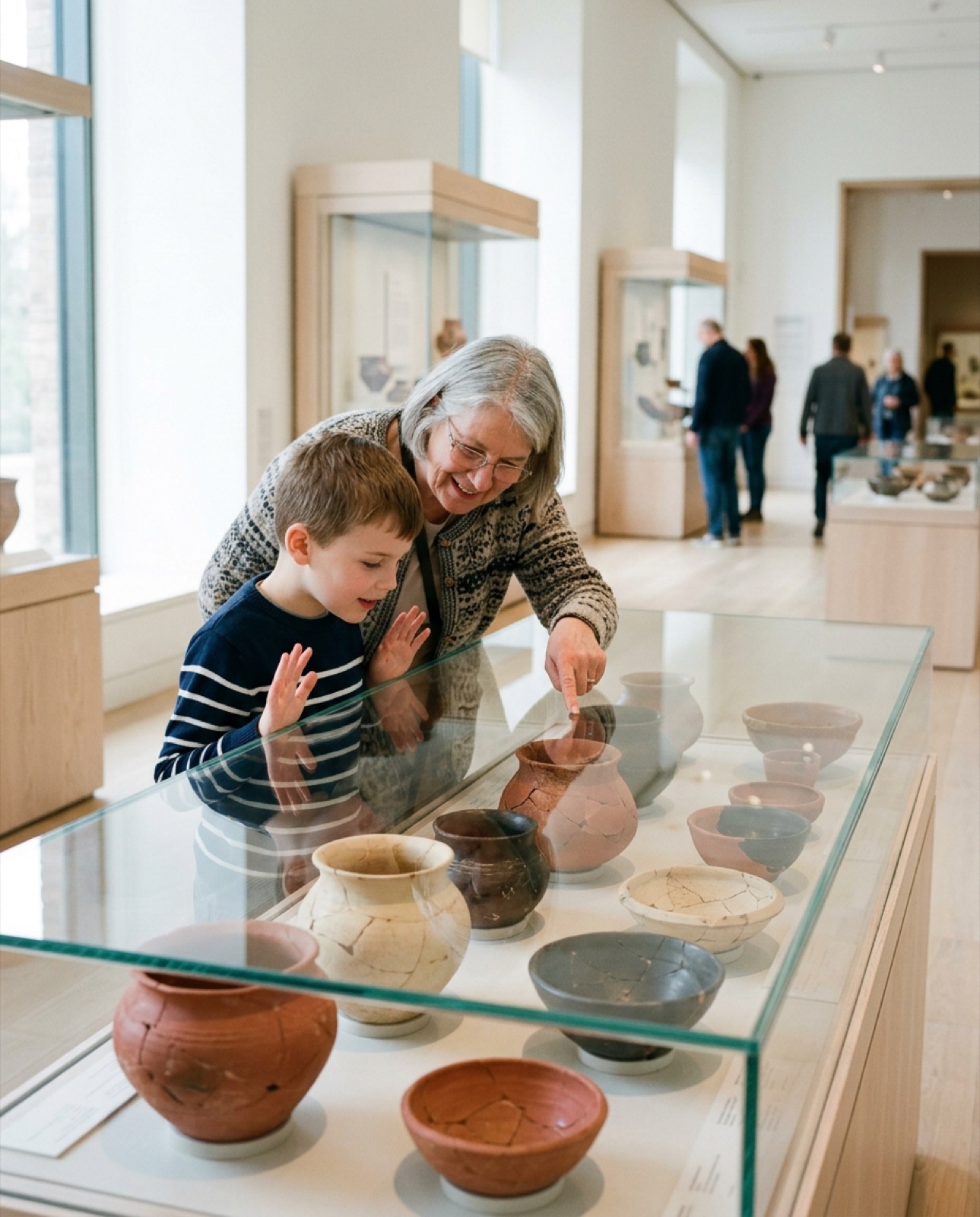
The visitor asks
“Okay, I need to interrupt you. I think this is boring. What am I actually looking at?”
Henry
“You’re standing on a giant Viking wall! Look down: the white markers show where sixteen enormous wooden houses once stood inside the circle. A thousand years ago, warriors marched through four gates, fires smoked, hammers rang, and horses moved along wooden roads. King Harald Bluetooth built this place to show everyone that he was powerful enough to shape an entire kingdom.”
The visitor asks
“Can you tell me something more interesting?”
Henry
“Here’s a delicious reversal: in 1882, the modest Aluminia faience factory bought the grand Royal Copenhagen porcelain manufactory.”
The visitor asks
“Okay, you told me that already. I want to hear a different story.”
Henry
“Then let’s leave the factories behind. In 1790, Denmark began making the Flora Danica service as a grand gift for Catherine the Great of Russia. But she died before it was finished, so the porcelain never reached her table. A diplomatic gift turned into a family treasure, still appearing at important Danish dinners centuries later.”
The visitor asks
“I’ve never been here before and I’ve got about an hour. Where should I start?”
Henry
“Then let’s not try to see everything. Start in the Gallery of Honour – one long room, and at the far end the Night Watch, the size of a wall. Walk it slowly and stop wherever you slow down on your own. I’ll be here. Ask me about anything you pass, and if you’d rather go your own way entirely, say so and we’ll follow that instead.”
The visitor asks
“Honestly, I don’t really like old paintings.”
Henry
“Fair enough. Then skip the Gallery of Honour and go to the doll’s house instead. It was furnished by a woman in Amsterdam who had it built room by room, in real materials, at enormous cost – the sort of money that bought a house on the canal. Everything in it is the size of your thumb. Tell me what you are standing in front of and I’ll take it from there.”
Four visitors, four museums, and not one of them asking the question a recording was made for. The words are real; the audio was recorded in quiet conditions rather than in a gallery.
Not another audio guide. A conversation.
Visitors can interrupt, ask, double back and go deeper. Henry does not select a track and play it; he answers, and the next thing he says depends on what the visitor said before.
Listen → Follow → Finish
Ask → Listen → Explore
You design the journey. Henry walks it with every visitor.
A museum shapes an experience on purpose, and the first question every curator asks is whether a talking guide will undo it. It does not. You decide how much to guide and how much to open up, and Henry carries your intent to every visitor.
“Just ask about whatever catches your eye.”
“Shall I take you through the exhibition?”
The museum sets the mode. Questions branch off the path and return to it.
A better experience for visitors. Better insights for museums.
A personal, conversational way to explore the collection.
Spoken, in their own language, at their own pace. No screen to navigate, nothing to scan, their eyes on the object rather than on a device.
A new way to understand what your visitors are curious about.
Every question a visitor asks is a piece of evidence about what your collection is doing in the room. That material is generated today, in text, in the EU.
Go beyond knowing where visitors go. Understand what makes them curious.
Counting visitors tells you where people stood. A question tells you what they wanted to know while they were standing there.
- What visitors ask about, in their own words
- Which works generate questions, and which are walked past
- Which stories hold people, and where they stop
- What they wanted that your interpretation did not cover
Designed for museums. Built around your collection.
Short answers to the things a museum has to be sure of before anything goes into its rooms. Each one has a longer version behind it.
Your content
Built around your collection and the records you already keep.
Your words and your rights
He reads public sources for facts and retells them in his own words. Your text is never republished, and no AI is trained on your data.
Accuracy
Thirteen quality gates run on every build. Nine of them stop a release.
Privacy
Conversations are kept as text, never as audio recordings, and the data sits in the EU.
Implementation
Visitors use their own phone and earphones. There is no hardware to buy, hand out, charge or clean.
What we can put in front of you today.
30+
Museums and heritage sites on the platform, built from published sources.
10,000+
Works with their own record behind them.
6
Languages live today: English, German, French, Spanish, Italian and Danish.
70+
Languages are possible. Adding one is fast, easy and cost effective.

Give every visitor a guide of their own.
See what AITourPilot could look like in your museum.